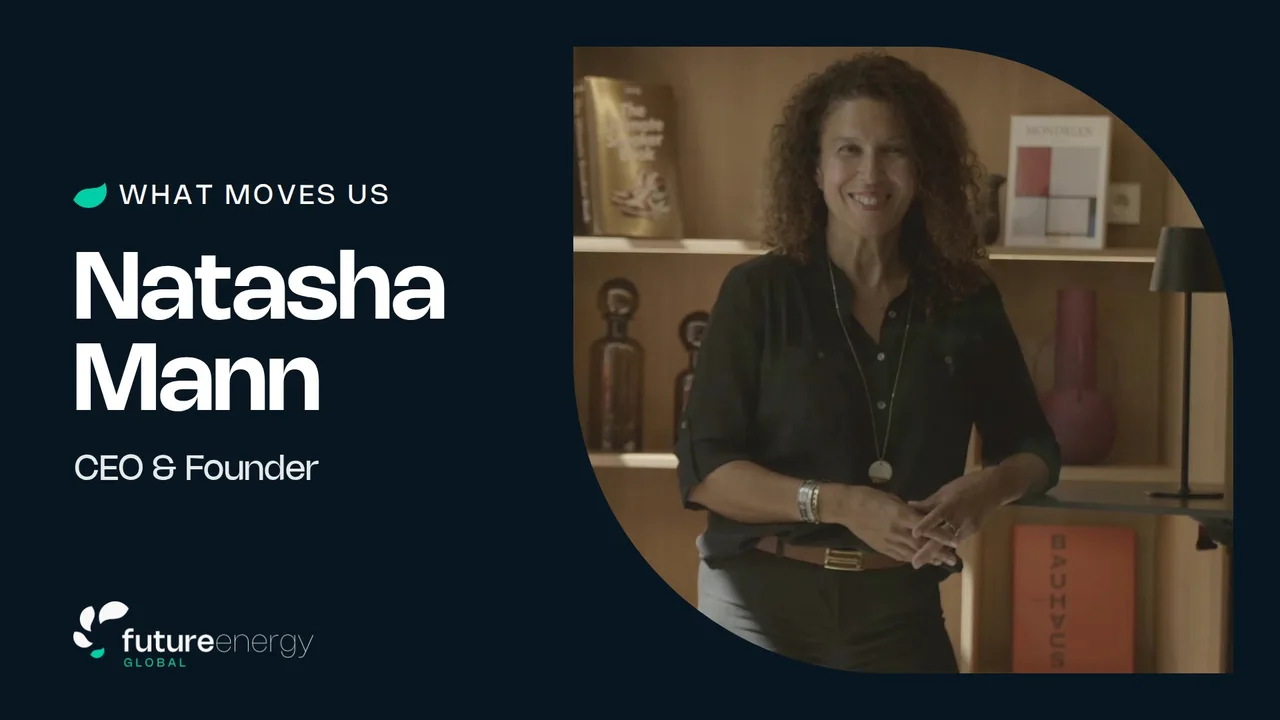
What Moves Us: Natasha Mann
Plays from YouTube. Nothing is sent to YouTube until you press play.
Natasha Mann chose aerospace engineering because she wanted to get on aircraft, not build them. In the first What Moves Us film she talks about Ladakh, the mountains and the sea, and where she thinks Future Energy Global fits.
Natasha Mann, CEO and Founder, filmed for What Moves Us, September 2026.
Filmed and edited by Marie Desage.
Transcript
When you grow up in the mountains and you grow up next to the sea with a father who is an adventurer, sustainability becomes part of your soul, your brain, your DNA, part of your fibre. And then that morphs into something bigger, like doing these treks to understand other cultures and to reach mountaintops, to have a bigger view of the world where you feel really small. If you wake up one day and you realise that what you’re contributing to has a negative impact on all the nature that you’ve grown up around, you can’t continue to work like that.
And then my father died when I was 12 years old, and money was super tight. And my mother always said, “Knowledge is power. You’ve got to go out and get your university degree, and then you have your freedom.”
What always drove me in terms of the selection of aerospace engineering was this desire to go on an adventure just the same way that we had done when we were young. So the selection of an aerospace engineering degree wasn’t because I was passionate about actually building an aircraft. It was actually because I was passionate about getting on an aircraft.
When you have limited means, you figure out a way to do your adventures. And doing something like mountain biking across Ladakh, the Leh-Manali Highway, you need your plane ticket to get to these places. But after that, you just need a good bike, really.
If you want to do a really good study in sustainability, go to Ladakh, because what you see there is a culture and a people who have the best circular economy. Nothing at all gets wasted in that culture. Once tourism was introduced, the lack of care that these so-called adventurers and explorers, which we were, had for how plastics would be treated for these people that had opened up their homes was shocking. We’re all visitors on this planet, whether it’s here in our own homes or over in Ladakh. And we need to take care of the planet, because otherwise it destroys the village which we all live in.
We need to go fast to be prosperous, but we need to slow down to be thoughtful, to get it right. And this push and pull is something that we’re always trying to balance. We want to sit at the middle.
As you start to create a market, you need a catalyst in order to make it flow. You have a lot of projects. I think we’ve counted now 500 SAF projects that need funding. And you have, on the other side of the coin, trillions of dollars that could flow into these SAF projects. What’s missing in the middle is the return on investment. And so you need somebody to guarantee that those projects will get the revenue. And that’s us. That’s Future Energy Global.
And what’s great about our team is that everybody shares that vision. You don’t build a world-class company without a world-class team. We have that world-class team. Everybody in our team has got an incredible amount of deep domain expertise.
One day, you’ll be on an aircraft with 100% SAF and not even have to talk about it anymore. Transportation will be sustainable. And we can go back to when I was four years old, going up into the cockpit back in 1978. Nobody felt guilty about getting on that airplane. It was just the sheer joy to travel. And I think that’s the vision that everybody’s trying to get back to.
And we want our children to be able to appreciate nature and everything that the world has to offer the same way that we all did. And the only way that you can do that is to make the world a more sustainable place.